
Introduction:
Hey there! Have you ever wondered about the ancient civilizations of China? Imagine walking through a time when emperors ruled, grand palaces stood tall, and intricate art and philosophy flourished. Early Chinese civilization, dating back to as early as 2000 BCE, is a fascinating journey into a world rich with culture, innovation, and stories. So, grab a cup of tea and let’s take a casual stroll through ancient China together.
Setting the Stage: The Beginning of Chinese Civilization
Let’s start from the beginning. Ancient China’s story unfolds along the Yellow River, often called the cradle of Chinese civilization. Think of the Yellow River as China’s very own Nile—an essential lifeline that nourished early communities, helping them to grow and thrive.
You see, around 2000 BCE, early settlers began to form villages along this river. These early communities, like the legendary Xia Dynasty, are shrouded in myth and mystery. While the existence of the Xia Dynasty is still debated among historians, it sets the stage for the more documented eras that follow.
The Shang Dynasty: Bronze Age Brilliance
Now, let’s fast forward to the Shang Dynasty (c. 1600–1046 BCE), one of the first well-documented Chinese dynasties. Picture a society that’s already mastering the art of bronze casting, creating intricate weapons, tools, and even ritual vessels. The Shang were pretty savvy when it came to metalwork, and their bronze artifacts are some of the most beautiful and sophisticated in the ancient world.
But the Shang weren’t just good with bronze. They were also early pioneers in writing. They used oracle bones—yes, actual bones and turtle shells—to inscribe some of the earliest forms of Chinese characters. These inscriptions are like ancient Tweets, giving us snippets of what life was like back then. They asked questions about everything from the weather to royal family affairs, giving us a glimpse into their world.
The Zhou Dynasty: Philosophical Flourish
Next up, we have the Zhou Dynasty (c. 1046–256 BCE). Imagine a time when philosophy and thought flourished, much like the Golden Age of Greece. The Zhou era is when Confucius, one of China’s most famous philosophers, lived and taught. His ideas about morality, family loyalty, and social harmony have shaped Chinese culture for centuries.
Confucianism wasn’t the only game in town, though. This period also saw the rise of Daoism, a philosophy that emphasized living in harmony with the Dao, or the Way. Think of it as ancient Chinese Zen, promoting a simple, contemplative life in tune with nature. Laozi, the sage often credited with founding Daoism, would be like your ancient Chinese mindfulness coach, encouraging you to go with the flow and find balance in life.
The Qin Dynasty: Unification and Innovation
Let’s jump ahead to the Qin Dynasty (221–206 BCE). Although it was short-lived, the Qin Dynasty had a massive impact on China. Imagine a ruler so determined to unify his land that he connected various walls built by earlier states to create what we now know as the Great Wall of China. Yes, the First Emperor, Qin Shi Huang, was quite the ambitious character.
Qin Shi Huang didn’t stop at building walls. He also standardized weights, measures, and even the script used throughout the empire. This unification made trade and communication much more efficient. However, his reign was also marked by harsh legalism and strict control, which didn’t sit well with everyone.
And who could forget the Terracotta Army? Discovered in the 1970s, these life-sized clay soldiers were buried with Qin Shi Huang to protect him in the afterlife. It’s like an ancient blockbuster movie set, with thousands of unique, intricately designed figures standing guard for eternity.
The Han Dynasty: Golden Age of Prosperity
Following the fall of the Qin, the Han Dynasty (206 BCE – 220 CE) ushered in a golden age of prosperity and cultural development. Imagine a time when China’s borders expanded, trade flourished, and innovations in science and technology abounded.
The Han Dynasty saw the development of the Silk Road, an ancient trade route that connected China with the West. Picture caravans laden with silk, spices, and other exotic goods making their way across vast deserts and mountain ranges. This trade route not only brought wealth but also facilitated cultural exchanges, spreading Chinese inventions like paper and gunpowder to the rest of the world.
Under the Han, Confucianism became the state philosophy, influencing the governance and social structure of China. Education and civil service exams were highly valued, paving the way for a bureaucracy based on merit rather than noble birth. It was a time of great intellectual achievement and societal progress.
Daily Life in Ancient China
So, what was daily life like in ancient China? Well, let’s paint a picture. Imagine waking up in a small, bustling village surrounded by rice paddies. The majority of people were farmers, toiling in the fields to grow rice, wheat, and millet. Agriculture was the backbone of society, and festivals often revolved around the agricultural calendar.
Families were large and tightly knit, with multiple generations living under one roof. Respect for elders and ancestors was paramount, and family rituals and ceremonies played a significant role in daily life. Homes were typically made of wood and earth, with thatched roofs and simple furnishings.
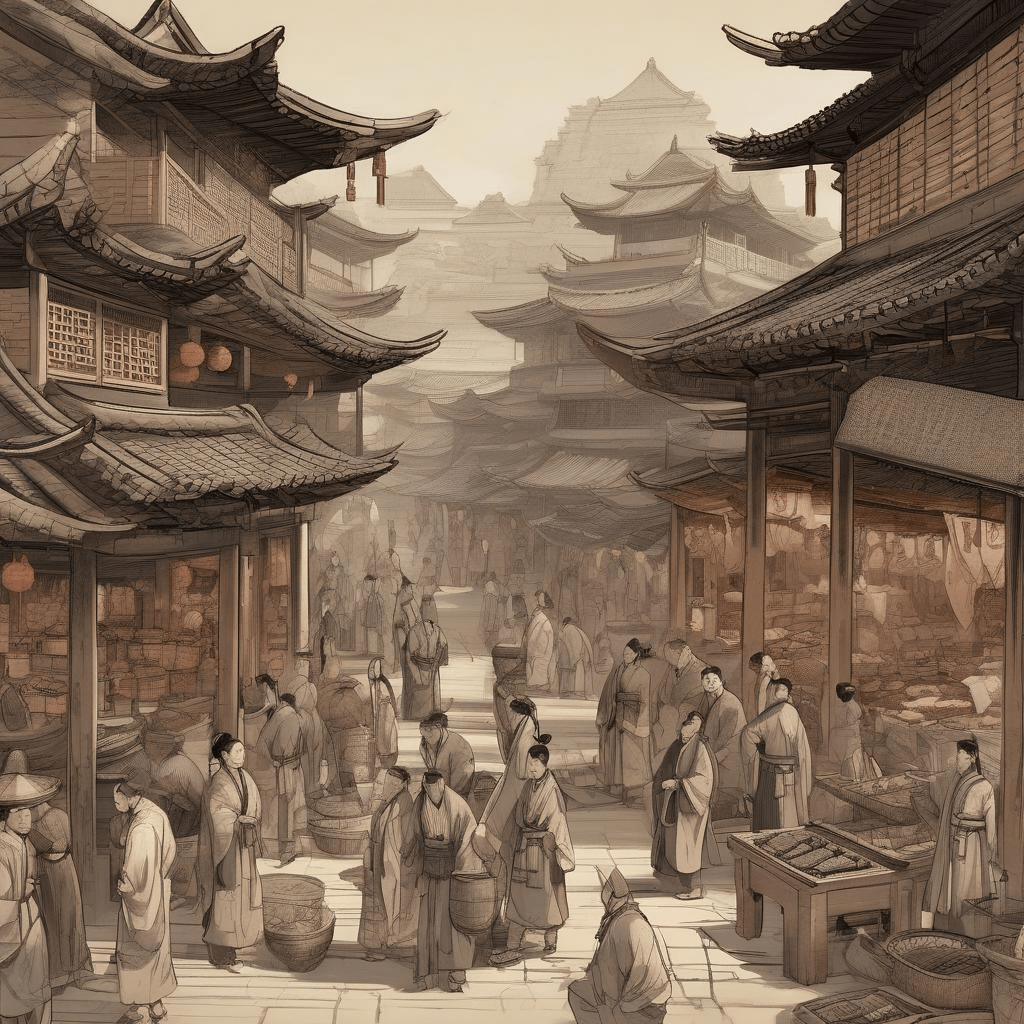
In towns and cities, artisans and merchants thrived. Markets were lively places, where one could find everything from pottery and textiles to exotic spices and herbs. Education was highly valued, especially for boys, and schools often focused on teaching Confucian classics, poetry, and calligraphy.
Religion and Beliefs
Religion and beliefs in ancient China were diverse and deeply ingrained in everyday life. Ancestor worship was a cornerstone, with people believing that their ancestors’ spirits had the power to influence the living. Offerings and rituals were performed regularly to honor and appease these spirits.
Alongside ancestor worship, the Chinese believed in a pantheon of gods and spirits associated with nature, agriculture, and household affairs. Temples and shrines dotted the landscape, serving as places of worship and community gathering.
Buddhism also made its way into China during the Han Dynasty, blending with existing Daoist and Confucian traditions to create a rich tapestry of spiritual practice. Monasteries and temples became centers of learning and culture, contributing to the spread of Buddhist philosophy and art.
Art and Culture
Art and culture flourished in ancient China, with each dynasty contributing unique styles and innovations. From the intricate bronze vessels of the Shang to the elegant pottery of the Han, Chinese art is renowned for its beauty and craftsmanship.
Calligraphy and painting were highly esteemed art forms, with scholars and artists spending years mastering the brushstrokes and techniques. Poetry was another revered cultural expression, with poets like Qu Yuan and Li Bai leaving a lasting legacy with their evocative verses.
Music and dance also played a significant role in cultural life, with elaborate performances held during festivals and ceremonies. Instruments like the guzheng (a type of zither) and the pipa (a lute) created melodies that resonated through the halls of palaces and temples.
Science and Technology
Ancient China was a hotbed of scientific and technological innovation. The Chinese invented paper, which revolutionized writing and record-keeping, and later developed printing techniques that spread knowledge far and wide.
Gunpowder, another Chinese invention, would eventually change the face of warfare around the world. But its initial use was in fireworks, adding color and spectacle to festivals and celebrations.
The compass, essential for navigation, was also a Chinese creation. With it, explorers could venture further and mapmakers could chart more accurate routes.
Agricultural innovations like the iron plow and water-powered mills improved farming efficiency, supporting population growth and urban development.
Conclusion:
In conclusion, the early civilizations of China were marked by remarkable achievements in art, science, philosophy, and governance. From the legendary Xia to the prosperous Han, each dynasty left its indelible mark on Chinese history and culture.
As we’ve seen, ancient China was a land of innovation and tradition, where philosophy and science flourished alongside daily life. Whether through the stories of Confucius, the grandeur of the Terracotta Army, or the bustling markets of ancient towns, there’s always something new to discover about this fascinating period.
So, what do you think about the rich history of ancient China? Have any particular stories or inventions caught your interest? I’d love to hear your thoughts and questions in the comments below. Let’s continue this journey of discovery together!
Team AajTakGk.COM


 AAj TAK GK
Leave a comment